


Building EIHL Predictions with Limited Data
The first EIHL bet I ever placed was based on nothing more than a hunch and a team name I liked. It lost. The second was based on checking one stat — home record — and it won. The difference between those two bets captures everything you need to know about EIHL predictions: even basic data gives you an edge in a market where most bettors operate on gut feeling alone.
The EIHL’s 2025-26 season featured 10 teams playing 270 matches to a total attendance of 1,321,128 — an average of 3,863 per game. That attendance figure represents years of steady growth and a genuine fanbase, but it hasn’t translated into the kind of deep statistical infrastructure that NHL bettors take for granted. There’s no equivalent of Natural Stat Trick or MoneyPuck for British hockey. The data exists, but you have to find it, organise it, and build your own analytical framework from the ground up.
That scarcity is the opportunity. When data is hard to find, fewer bettors bother to find it. Bookmakers price EIHL markets with less sophistication than NHL markets because the volume is lower and the modelling investment isn’t justified by the handle. Your research effort faces less competition, which means even modest analysis can produce a meaningful edge.
Where to Find EIHL Stats and Team Data
EIHL attendance has grown 33.9% over four seasons, climbing from an average of 2,885 per match in 2021-22 to 3,863 in 2025-26. That growth has brought more media coverage and, with it, more accessible data — though the data landscape remains fragmented compared to the NHL.
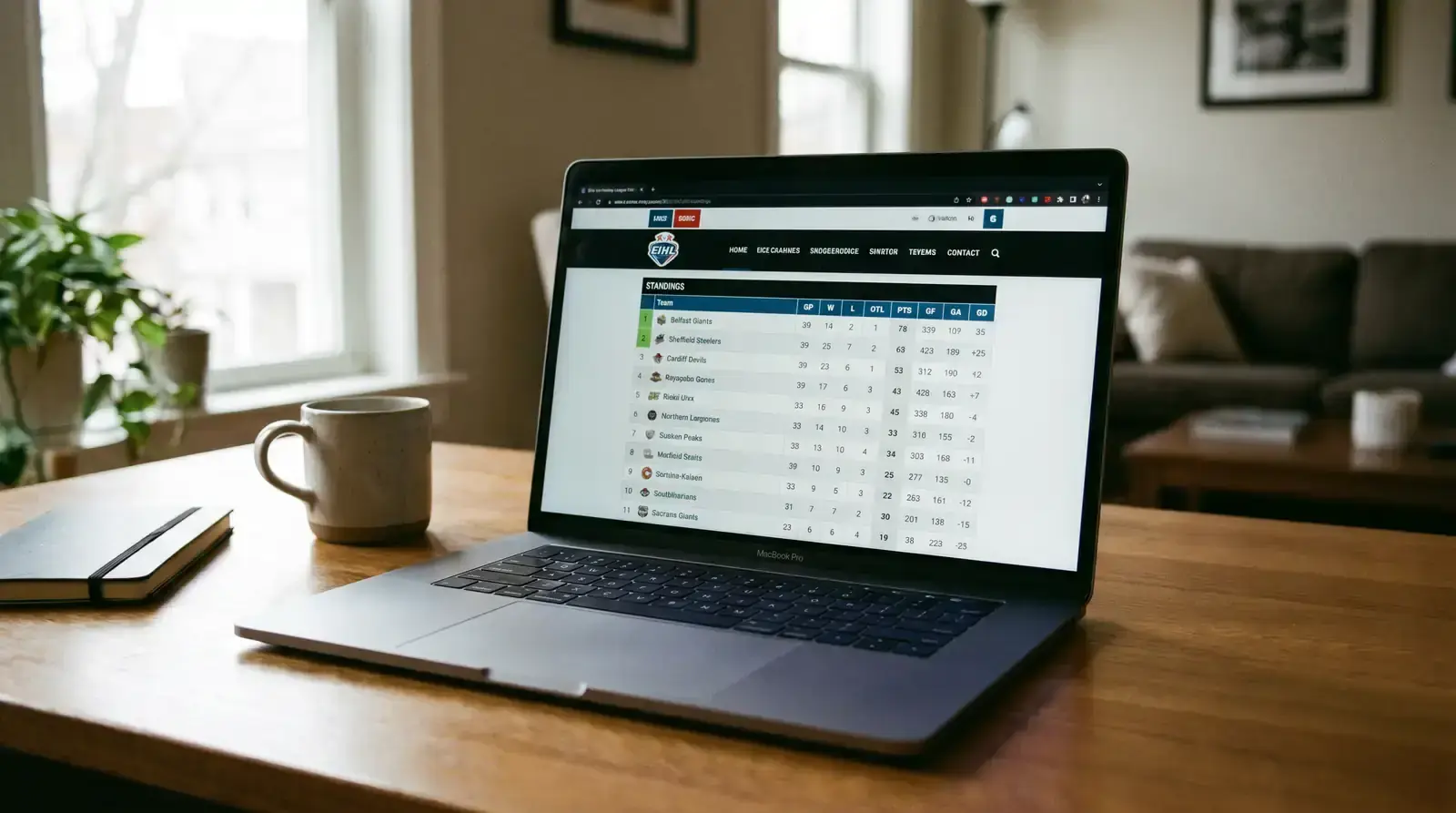
The EIHL’s official website publishes standings, results, and basic player statistics (goals, assists, points, penalty minutes). This is your starting point. Game scores and standings tell you which teams are performing well and which are struggling, but they don’t tell you why. For that, you need to dig deeper.
Team social media accounts and local media outlets are surprisingly valuable for EIHL data. Beat reporters for teams like the Belfast Giants, Sheffield Steelers, and Nottingham Panthers often share roster updates, injury news, and line combinations that aren’t available on the league’s official channels. Following four or five of these reporters on social media takes ten minutes and gives you access to the kind of soft information — who’s injured, who’s been promoted to the first line, which import player has been released — that moves EIHL lines but doesn’t show up in any database.

For historical data, the EIHL section on Elite Prospects provides career statistics for players, which helps you assess the quality of new imports. When a team signs a new import forward from a Swedish or Finnish second-division club, that player’s historical stats give you a baseline for how they might perform in the EIHL. The transfer window is one of the most impactful periods for EIHL predictions because roster turnover is high — import rules limit the number of non-British players per team, and those slots generate constant movement.
Form vs Class: Which Matters More in EIHL?
In the NHL, class — the underlying quality of a roster — eventually asserts itself over a large sample of 82 games. In the EIHL, with a smaller sample and higher roster volatility, form matters more. A team on a six-game winning streak in the EIHL is riding genuine momentum that often correlates with a stable roster, healthy imports, and a goaltender in form. That momentum is more predictive of the next result than the team’s season-long record.

I weight the last six games more heavily than the last twenty when building EIHL predictions. The reason is roster instability. An EIHL team in October might have a completely different forward group by January due to import changes, injuries, and mid-season trades. The team’s record in October tells you very little about the team you’re betting on in January. Recent form captures the current iteration of the roster, which is what actually takes the ice.
Home advantage is stronger in the EIHL than in the NHL. Teams like the Belfast Giants, who play in a purpose-built arena with a passionate local fanbase, post home win rates that consistently exceed 60%. The atmosphere in EIHL arenas — small, loud, and intense — creates a genuine environmental factor that teams must overcome when travelling. I apply a home advantage adjustment of 5-8% in my models, compared to 3-4% for NHL games.

One caveat: when a team has recently changed coaches or released and replaced two or more import players, throw recent form out the window. The new combination hasn’t played enough games together to produce meaningful form data. In those situations, I revert to assessing individual player quality and coaching tendencies rather than team-level results.
A Weekly EIHL Research Workflow
Michael Dugher, the former CEO of the Betting and Gaming Council, pointed out that problem gambling statistics had fallen again — a reminder that responsible research and wagering go hand in hand. My EIHL research workflow is designed to be thorough but time-efficient, taking roughly 45 minutes per week.

Monday: review the weekend’s results. Check scores, identify any surprising outcomes, and note any teams that performed significantly above or below expectations. Update my standings tracker with current points, goal difference, and home/away splits.
Tuesday-Wednesday: scan team news. Check the EIHL website and social media for roster moves, injury updates, and any import player changes. A single import release-and-replacement can change a team’s strength by more than any NHL trade.
Thursday: build the weekend betting card. Identify the fixtures I want to target, assess goaltender availability (EIHL teams typically carry two goaltenders, and the starter/backup split matters just as much as it does in the NHL), and set target prices for each game. I usually find three or four games per weekend that I have a strong enough view to bet on.
Friday: line shopping. Check which bookmakers have published EIHL odds and compare prices. EIHL lines move less than NHL lines because the volume is lower, but early movers can still capture slightly better prices. Place bets on any games where the available price meets or exceeds my target.
This workflow doesn’t require advanced statistical tools or expensive data subscriptions. It requires consistency, curiosity, and a willingness to seek out information that most bettors don’t bother to find. In a market as thinly covered as the EIHL, that’s enough.
