

Why More Than Half of All Bets Are Now Placed Live
I used to treat live betting as entertainment — a way to stay engaged with a game I was already watching. Then I ran my numbers at the end of a season and discovered that my in-play bets on hockey had a higher strike rate than my pre-game selections. Not by a little. By enough to make me restructure my entire approach around the live market.
The data backs up the shift. DraftKings reported that live bets exceeded 50% of total handle for the first time in Q1 2025, with in-play action on baseball alone surging 36% year on year. Hockey follows the same trajectory. At bet365, in-play betting accounted for 68% of sports revenue as far back as 2021 — a figure that has only grown as streaming access and real-time data feeds have improved. The industry isn’t moving towards live betting. It’s already there.
Hockey is structurally ideal for live betting in ways that football and tennis aren’t. Three twenty-minute periods with intermissions between them create natural pause points for assessment. Goals arrive frequently enough to generate regular price movement but not so frequently that the market becomes chaotic. Power plays, penalty kills, and goaltender changes create predictable momentum shifts that the sharp bettor can anticipate and act on before the market fully adjusts.
What makes live hockey betting dangerous is the same thing that makes it profitable: speed. Odds move within seconds of a goal, and the window to capture value before the market corrects is narrow. If you’re betting live without a plan — without knowing which situations you’re looking for and what price represents value — you’re gambling reactively instead of betting strategically. This guide lays out the framework I use to keep live hockey betting disciplined and data-informed.
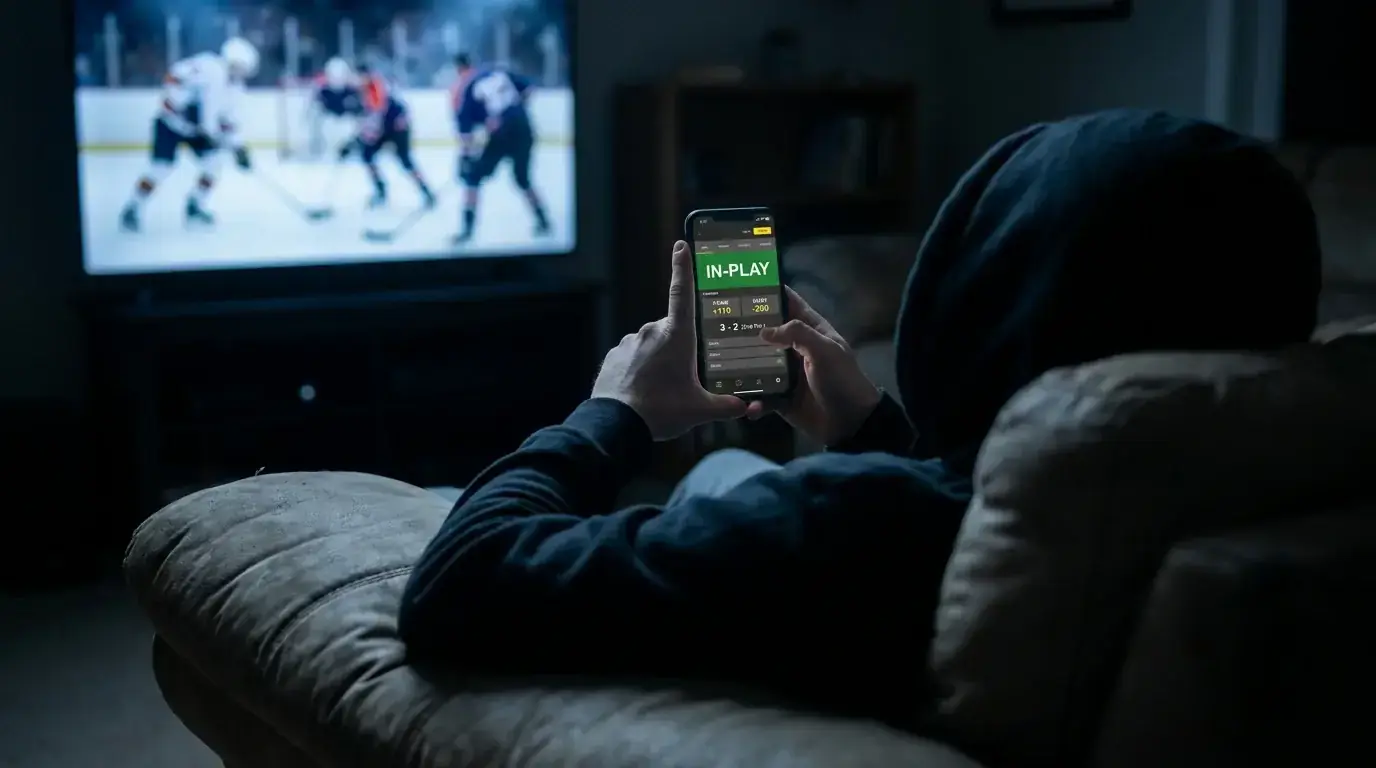
In-Play Markets Available for Hockey
The live market offering for NHL hockey at UK bookmakers has expanded significantly in the past two seasons, but it still doesn’t match the depth you’d find for Premier League football. Knowing exactly what’s available — and what’s missing — helps you focus your live betting on the markets where you actually have an edge.
Live Moneyline and Period Winner
The live moneyline is the backbone of in-play hockey betting. It updates continuously based on the current score, time remaining, and the bookmaker’s model of each team’s win probability. After a goal, the moneyline adjusts within seconds — sometimes faster than your stream shows the puck crossing the line, which is a latency issue I’ll address later.
Period winner markets run alongside the overall moneyline and reset at the start of each period. These are effectively three separate mini-bets per game, each with its own dynamics. The first period tends to be the tightest defensively, with both teams feeling each other out. The second period often produces the most goals, as coaches make tactical adjustments and fatigue hasn’t yet become a factor. The third period is where situational dynamics dominate — trailing teams take more risks, leading teams tighten up, and the threat of an empty-net goal in the final two minutes distorts the scoring landscape.
I use period winner markets most heavily in the second period, where I’ve found the most consistent gap between my assessment and the bookmaker’s in-play pricing. By the time the second period starts, I’ve had twenty minutes to evaluate each team’s shot volume, puck possession patterns, and goaltender sharpness. That information isn’t fully captured by the live model, which relies more heavily on the score and time remaining than on quality-of-play indicators.
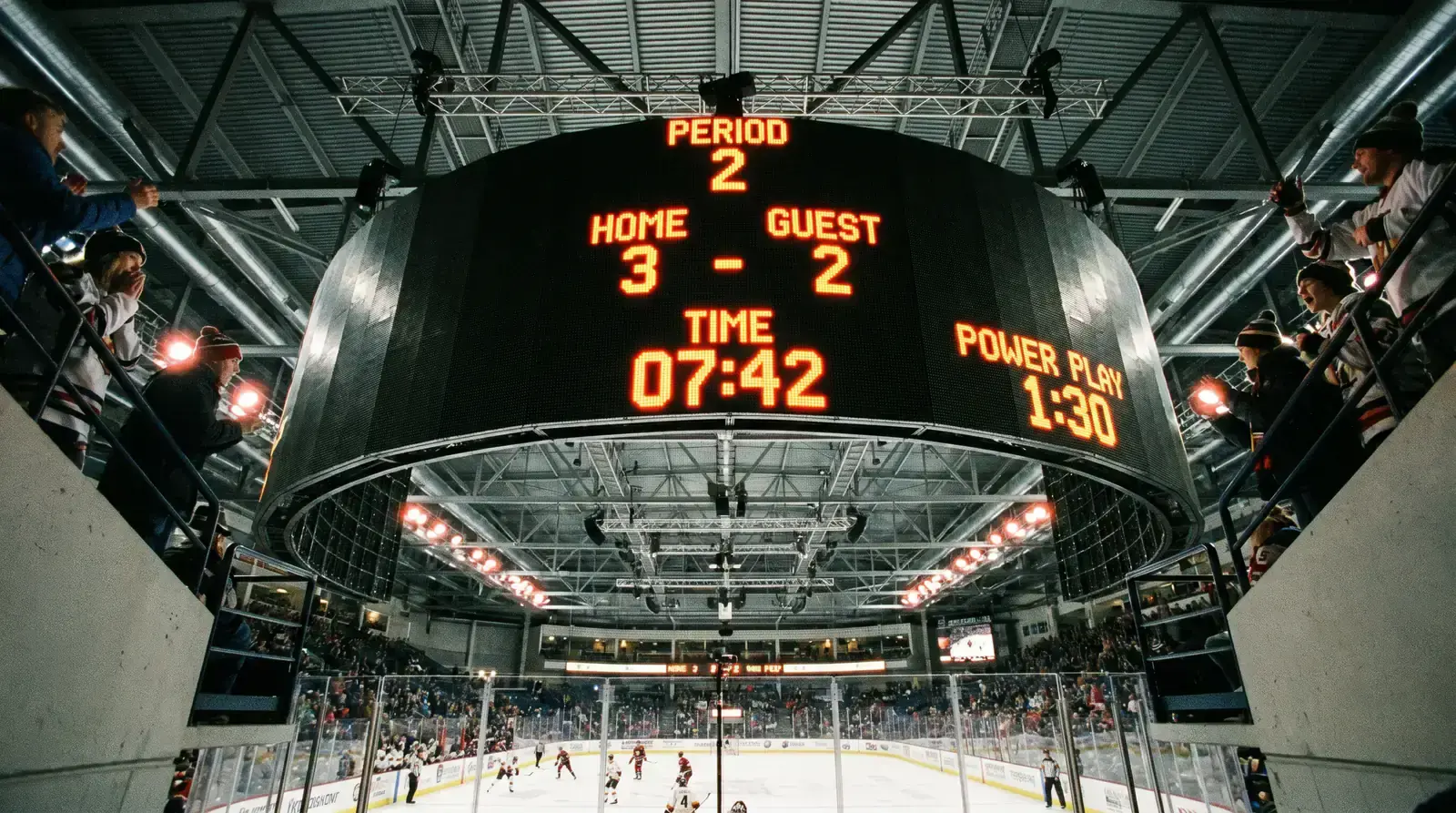
Running Totals and Live Props
Running totals adjust the pre-game over/under line based on goals already scored. If the pre-game total was 6.5 and it’s 3-2 after two periods, the live total for the remaining period might be set at 1.5 or 2.5. These markets let you bet on scoring pace in a more granular way than the pre-game total allows.
NHL totals typically open around 6 or 6.5, reflecting a league average of roughly six goals per game. But that average masks enormous variation. Some games are 1-0 defensive battles after two periods; others are 5-4 shootouts by the end of the first. The live totals market lets you react to what’s actually happening on the ice rather than what the pre-game projection assumed would happen.
Live props are the least developed segment of NHL in-play markets at UK bookmakers. Some operators offer next team to score, next period total, and anytime goalscorer during the game, but the coverage is inconsistent. Player-specific live props — next player to record a shot on goal, for instance — are rare at UK-facing operators, though they’re standard at US sportsbooks. This gap represents an area where UK coverage will likely expand as operator investment in live hockey data continues to grow.
The practical limitation with live props is execution speed. By the time you’ve identified value in a “next team to score” market and navigated to it on your bookmaker’s app, the odds may have shifted. For cash out decisions on live bets, the same speed issue applies — the cash out value changes with every shift in the live odds, and hesitation costs money in both directions.
Game Events That Shift Live Odds
Not every in-game event moves the odds equally. A goal in the first minute of the first period has a different impact on the live moneyline than the same goal with three minutes left in the third. Understanding which events create the most significant price movement — and which create the best opportunities for value — is what separates reactive live bettors from strategic ones.
Goals are the obvious trigger, but the context of the goal matters as much as the goal itself. An even-strength goal that gives a team a 2-0 lead in the first period moves the line less than a shorthanded goal that ties the game at 3-3 in the third period. The latter represents a momentum shift, a psychological blow, and a statistical anomaly (shorthanded goals are rare, so the market overreacts to them). I look specifically for overreactions — moments where the emotional intensity of the event exceeds its actual impact on the likely outcome.
Power Play and Penalty Kill
When a referee’s arm goes up for a penalty, the live odds shift before the penalised player even reaches the box. A two-minute power play gives the advantaged team roughly a 20% chance of scoring, depending on their season-long power play percentage, and the live market prices that expectation in immediately.
The opportunity for value during power plays comes from two sources. First, not all power plays are equal. A team with a 28% power play conversion rate creates a different expected outcome than one at 16%, but the live odds adjustment doesn’t always differentiate with that precision, especially for less popular matchups where the operator’s model uses league-average inputs. If you know a team’s power play is significantly above or below average, you can identify moments where the live price misprices the actual scoring probability.
Second, the penalty kill creates defensive pressure that persists after the power play ends. A team that kills a penalty successfully often generates a momentum boost that carries into the next few minutes of even-strength play. The live odds reset to normal after the penalty expires, but the on-ice dynamics don’t reset as cleanly. That residual momentum is an edge that the live model doesn’t capture.
Five-on-three power plays — where the opposing team has two players in the penalty box simultaneously — are rare but dramatic. They produce goals at nearly double the rate of standard power plays, and the live odds swing violently. The best approach during a five-on-three isn’t to bet on the power play team to score (the market has already priced that in aggressively), but to assess whether the post-power-play dynamics create value on the broader moneyline or period total.

Empty Net and Goalie Pulls
The last two minutes of a close NHL game produce some of the most volatile live odds movement in any sport. When a trailing team pulls their goaltender for an extra skater — creating a six-on-five situation — the probability of them scoring increases, but so does the probability of the leading team scoring an empty-net goal. The live market tries to balance both scenarios simultaneously, and it doesn’t always get the calibration right.
Empty-net situations typically arise when a team trails by one goal with ninety seconds to two minutes remaining. The trailing team replaces their goaltender with a forward, gaining an offensive advantage but leaving their net unprotected. The live moneyline at this point has already heavily favoured the leading team, but the totals market is where I find the most interesting pricing. An empty-net scenario substantially increases the probability of at least one more goal being scored — either by the trailing team tying it up or by the leading team firing the puck the length of the ice into the empty cage. If the live total hasn’t adjusted to reflect this increased scoring probability, there’s value on the over for the remaining game time.
In-game goaltender changes are a separate trigger. If a starting goaltender is pulled after allowing four goals on twelve shots — a clear performance crisis — the backup enters and the live odds adjust. But the adjustment is often conservative, because the bookmaker’s model doesn’t fully account for the psychological boost a team gets from a fresh goaltender and a tactical reset. I’ve seen backup goaltenders enter a game and immediately stabilise a team’s defensive structure, with the live odds catching up over the following ten minutes rather than reflecting the change immediately.

Streaming Access and Latency for UK Bettors
Here’s a frustration every UK-based live hockey bettor knows intimately: you’re watching an NHL game on a streaming platform, a goal is scored, and by the time your screen shows the puck hitting the net, the live odds at your bookmaker have already moved. The stream is ten to forty seconds behind the actual live action, and in that gap, the price you wanted has vanished.
This latency issue is the single biggest practical challenge for live hockey betting from the UK. Bookmakers receive data feeds from in-arena tracking systems that update in near real-time. Streaming services deliver video through content delivery networks that introduce unavoidable delay. The result is that you’re always betting on information you’ve already seen, while the bookmaker is pricing based on information you haven’t seen yet.
Tim Miller, Executive Director of the UK Gambling Commission, has discussed the broader regulatory landscape around how technology intersects with gambling, including how crypto assets might function as payment options for licensed operators. That forward-thinking approach to tech suggests the Commission is aware of how technological infrastructure shapes the betting experience — including the latency gap that affects in-play markets.
The practical workaround isn’t to try to beat the latency — you can’t. Instead, it’s to build your live betting approach around situations where you have an analytical edge that persists beyond the immediate price reaction. A goal changes the score, and the live odds adjust instantly. But the systemic implications of that goal — how it affects the trailing team’s tactical approach, whether it triggers a goaltender change, how it shifts the power play and line-matching dynamics for the rest of the game — take time to manifest. Those systemic implications are where your edge lives, and they don’t require you to see the goal before the bookmaker does.
For UK bettors who want to watch games live, the available options include NHL streaming packages, sports-specific platforms, and some bookmakers’ own in-app streaming for customers with funded accounts. The quality and availability vary by operator and by game, and blackout restrictions can affect which fixtures are available for live viewing in the UK. Check the streaming options at your bookmaker before assuming you’ll have access to a specific game.

Discipline and Bankroll Control in Live Betting
The night I lost 40% of my hockey bankroll in three hours of live betting was the night I wrote my live betting rules. I wasn’t making bad picks — I was making too many picks, at too-high stakes, in a state of escalating excitement that had nothing to do with analysis. Live betting is designed to feel urgent, and urgency is the enemy of discipline.
Among online sports bettors, 8.9% meet the criteria for problem gambling according to a meta-analysis published in The Lancet Public Health. Live betting amplifies the risk because the speed of decision-making compresses the feedback loop — you bet, you see the result within minutes, and the impulse to bet again is immediate. The intermissions in hockey games provide natural stopping points, and I use them ruthlessly. Between periods, I step away from the screen, review what I’ve bet, and decide whether I’m still operating within my plan or reacting to emotions.
My live betting rules are simple. I set a maximum number of live bets per game — typically two. I set a maximum stake for any live bet at half my standard pre-game unit size. And I have a hard stop: if I lose two consecutive live bets, I’m done with live action for the night, regardless of how many games are still in progress. These rules aren’t optimal from a pure expected-value perspective — there are nights when a third or fourth live bet would have been profitable. But they prevent the catastrophic sessions that wipe out weeks of careful pre-game work.
Bankroll separation is the other critical piece. I allocate a specific percentage of my monthly hockey bankroll to live betting — no more than 25%. If I exhaust that allocation, I stop live betting for the remainder of the month. This prevents the common trap where a bettor uses live betting to chase pre-game losses, which is the fastest way to destroy a bankroll in any sport.
Optimal Timing Windows During a Hockey Game
After six years of tracking my live hockey bets, I’ve identified three windows within a game where the live market is most likely to misprice the actual probabilities. These aren’t guarantees of value — they’re situations where the structure of the game creates conditions that the live model handles less efficiently.
The first window is the opening five minutes of the second period. The intermission allows both teams to regroup, and the second period often starts with a shift in territorial dominance that wasn’t present in the first. If a team was outplaying the opponent in the first period but losing on the scoreboard — a scenario that happens more often than you’d think in a sport with as much random variance as hockey — the second period is where their process tends to produce results. The live odds at the start of the second period still anchor heavily to the first-period score, which creates an opportunity when the underlying quality gap is wider than the score suggests.
The second window is immediately after a penalty kill. A successful kill generates momentum that the live model often underprices. The shorthanded team has just survived a high-pressure situation, their penalty killers are energised, and the power play team frequently experiences a psychological letdown. The live odds revert to their pre-penalty levels once the penalty expires, but the on-ice dynamics often favour the killing team for the next three to four minutes. That residual momentum is real and underpriced.
The third window is the final five minutes of the third period in a game within one goal. This is when tactical decisions cascade. The trailing team increases their offensive aggression, pulls their goaltender earlier if they’re desperate, and takes risks that create both scoring opportunities and defensive vulnerabilities. The live totals market in this window tends to underestimate the probability of at least one more goal being scored, because the model treats the remaining time as linear when the actual game state has shifted to a high-variance mode.
These three windows account for the majority of my profitable live bets over the past four seasons. Outside of them, I’m largely observing rather than betting — gathering information that informs my pre-game selections for future games rather than forcing live action in periods where I don’t have a structural edge.