


What Makes NHL Betting Different from Football Wagering
I spent my first three years betting exclusively on the Premier League. Good results, too — consistent enough to think I had the whole thing figured out. Then a mate dragged me to a Belfast Giants game in 2019, and within a week I’d placed my first NHL wager. The adjustment was brutal. Everything I thought I knew about reading form, timing my bets, and trusting the favourite got flipped on its head.
That disorientation is exactly where the opportunity lives. NHL betting operates on a different logic to football, and the punters who recognise that early save themselves months of frustration. The average NHL regular season game draws 546,000 viewers across ESPN, ABC, and TNT in the 2025-26 season — a 25% jump year on year and the highest figure in 14 years. The audience is growing, the markets are deepening, and the sport rewards a type of analysis that most UK bettors already have the instincts for but haven’t yet applied.
Here’s the core difference: football betting revolves around low-scoring matches where a single goal can define the entire outcome. NHL hockey, by contrast, averages around six goals per game, plays three distinct twenty-minute periods, and features a positional variable — the goaltender — that shifts implied probability by 3 to 5 percentage points on a single announcement. The pace of scoring creates more in-play opportunities. The schedule density creates fatigue angles. The salary cap creates parity that makes heavy favourites rarer than in any top European football league.
NHL viewers rank third among all US sports audiences by median household income, according to Nielsen’s Tops of Sports data. That translates directly into commercial momentum: the league pulled in a record $1.53 billion in sponsorship revenue during the 2024-25 season, up 9% year on year. When that much money flows into a sport, the betting infrastructure follows — more markets, tighter lines on headline games, and wider coverage at UK-facing bookmakers.
This guide breaks down the NHL season structure, the markets you’ll find at UK bookmakers, the factors that move lines before puck drop, and the timing considerations that come with betting on a North American league from this side of the Atlantic. If you’ve built any kind of process around football, most of the framework transfers. The details, though, are where NHL betting gets interesting.
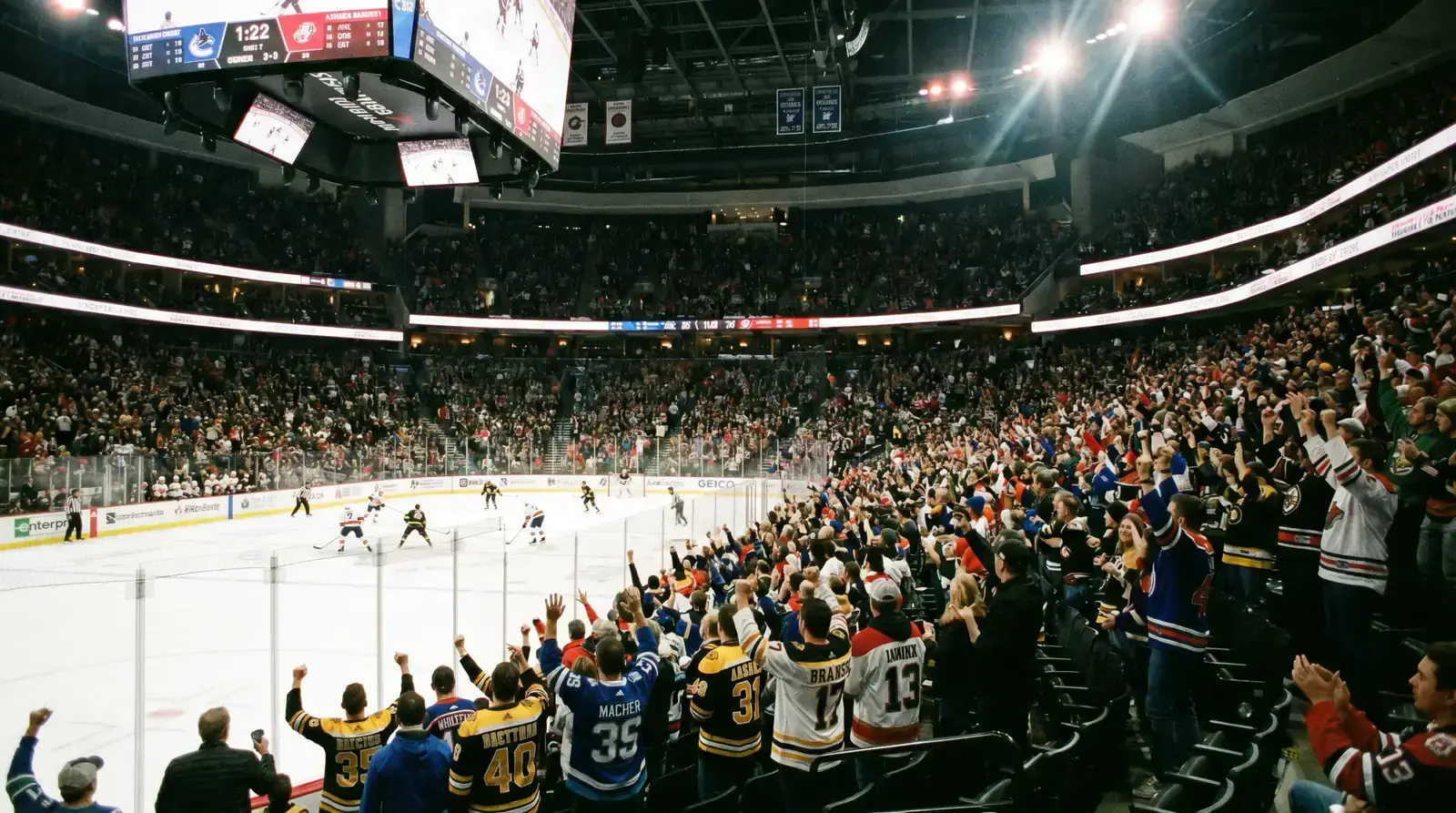
NHL Season Structure and Its Impact on Betting Markets
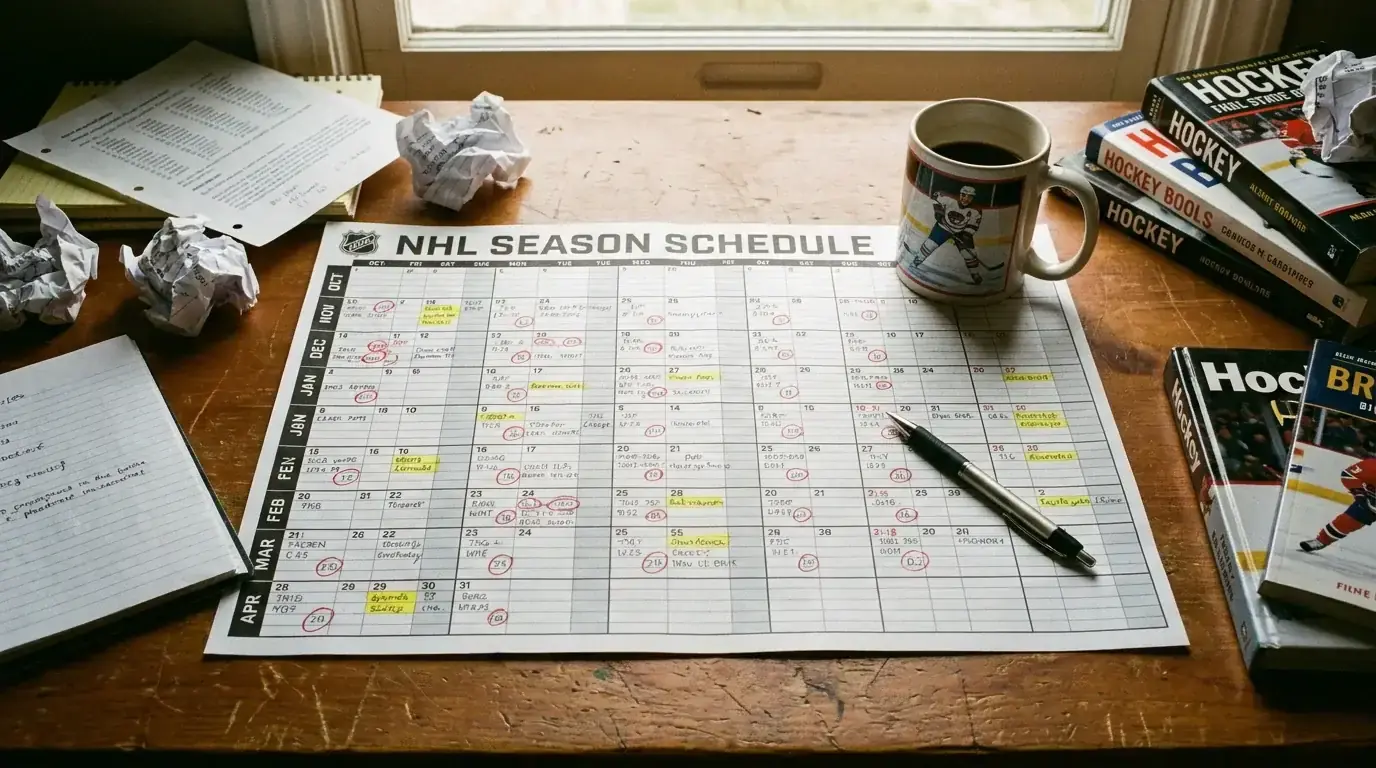
The first time I looked at the NHL schedule, I thought there’d been a printing error. Eighty-two regular season games per team, running from October through mid-April, followed by a playoff bracket that can stretch into late June. Compare that to the Premier League’s 38 matches and you start to see why NHL betting rewards patience and volume in a way football never quite does.
This sheer density has direct consequences for how lines are set and where value appears. Teams play on back-to-back nights, cross multiple time zones in a single week, and rotate goaltenders based on schedule load rather than form alone. Bookmakers adjust for all of this, but they can’t always do it perfectly — and that imperfection is where your edge lives.
The season divides into two structurally different phases, each with its own betting character. The regular season is a war of attrition with 1,312 total games across the league. The playoffs are a best-of-seven format that compresses variance and rewards depth. Your approach to each phase should be fundamentally different, and understanding why starts with how the calendar works.
Regular Season: 82 Games of Opportunity
Eighty-two games means every team plays roughly four times a week for six months. That kind of volume generates something football bettors rarely experience: enough data points within a single season to identify sustainable trends rather than chasing small samples.
The regular season runs from early October through mid-April. Each team plays 41 home and 41 away games, distributed across their conference and division opponents. Divisional rivals meet four times, conference opponents from outside the division face each other three times, and cross-conference matchups happen twice. This structure matters for betting because it creates familiarity — by February, teams in the same division have already played each other two or three times, and line-setters account for that history.
Where things get tactically interesting is the three-point loser system. Unlike football, where a loss is simply a loss, any NHL game that goes to overtime awards two points to the winner and one point to the loser. This means teams trailing late in the third period have a strong incentive to push for overtime rather than risk everything for a regulation win. In practice, that inflates the number of games decided after sixty minutes, which directly affects how you approach overtime rules and their impact on your bets.
From a betting perspective, the regular season splits into three informal phases. October through November is the settling-in period, when rosters are still being evaluated and line-setters rely heavily on preseason projections. December through February is the most data-rich window, with enough games played to trust team-level statistics. March through mid-April is the trade deadline and playoff-race stretch, when motivation becomes a significant variable — teams fighting for a Wild Card spot play differently to those who’ve already clinched.
I’ve found the most consistent value in that December-to-February window. Enough data exists to build reliable assessments, but bookmakers still anchor partially to preseason expectations. When a team’s actual performance diverges from those expectations, the market is slow to adjust, and that lag creates value.
Playoffs and the Stanley Cup Path
The Stanley Cup playoffs are a different sport. Sixteen teams qualify — the top three in each division plus two Wild Card entries from each conference — and every round is a best-of-seven series. The format compresses variance dramatically: over seven games, the better team wins more often than in a single football match. That sounds like it should make betting easier, but the market adjusts accordingly. Playoff lines are tighter, and the public money that floods in on marquee matchups squeezes value out of mainstream markets.
What changes most in the playoffs is pace and physicality. Regular season games average around six goals; playoff games trend lower as teams tighten defensively and goaltenders face higher-quality shots from more structured offensive systems. If you’re betting totals, that shift matters. The NHL Stadium Series match on 1 February 2026 pulled 2.1 million viewers — the most-watched regular season game on cable in NHL history — but playoff viewership dwarfs even those numbers, and with the eyeballs comes sharper public action that distorts prices.
For Stanley Cup futures, the playoff structure creates natural value windows. After the first round, public perception shifts dramatically — a team that sweeps its opponent looks invincible, even if the underlying data suggests a closer matchup than the 4-0 result implies. Second-round pricing often overreacts to first-round performance, and that’s where I’ve found some of my best futures entries.

Available NHL Markets at UK Bookmakers
Five years ago, finding NHL markets at a UK bookmaker meant scrolling past seventeen football leagues and hoping for a moneyline and maybe a total. That picture has changed substantially. New UK-facing operators added an average of 34% more niche sport markets year on year between 2024 and 2026, and hockey has been one of the primary beneficiaries of that expansion.
The core NHL markets available at most UK bookmakers now mirror what you’d expect from a Premier League fixture. Moneyline — or match winner including overtime and shootout — sits at the centre. The puck line, hockey’s equivalent of the Asian handicap, typically offers a standard handicap of plus or minus 1.5 goals, with alternative lines stretching from 0.5 to 3.5 at larger operators. Totals run from the standard 5.5 or 6.5 down to half-goal increments on team totals and individual periods.
Where the depth has really expanded is in player props and same-game parlays. The major UK books now offer anytime goalscorer, shots on goal, assists, and saves markets for most NHL games. Some go further with points totals, time on ice, and blocked shots. This is a genuine step change from even two seasons ago, when player props were limited to a handful of marquee fixtures.
Period betting has also matured. First period winner, period totals, and first team to score in a given period are standard at the larger operators. These markets are particularly useful for NHL because each period has a distinct scoring character — the third period plays differently to the first, and bookmakers don’t always price that difference as sharply as they should.
Futures markets cover the obvious — Stanley Cup winner, conference champions, division winners — but also extend to individual awards like the Hart Trophy for most valuable player and the Vezina for best goaltender. The depth of coverage varies by operator, and the smartest thing you can do before committing to a platform is check not just whether they offer NHL, but how many markets deep their coverage goes on a random Tuesday night fixture. A moneyline and a total is the bare minimum. If that’s all you’re getting, you’re leaving angles on the table.

One area where UK coverage still lags behind the US market is in-game micro markets — next team to score, next goal method, and specific minute-by-minute propositions. These exist at some operators but aren’t yet standard. As the live betting infrastructure improves, that gap should narrow.
NHL Viewership and Commercial Growth
Numbers tell a story that gut feeling can’t, and the NHL’s commercial trajectory is the kind of story that should make any bettor pay attention. Average regular season viewership hit 546,000 across ESPN, ABC, and TNT in the 2025-26 season — a 25% year-on-year increase and the league’s best number in fourteen years. ABC alone averaged 1.1 million viewers across its sixteen regular season broadcasts, up 33% on the previous season.
Why does viewership matter for betting? Because audience growth drives commercial investment, and commercial investment drives market depth. The NHL attracted 500 new sponsors in the 2024-25 season, with an average deal valued at $529,000. Total sponsorship revenue across all thirty-two teams reached $1.53 billion, a 20% increase compared to the 2022-23 season. Sara Slane, then Senior Vice President of Public Affairs at the American Gaming Association, framed the relationship directly: legal sports betting represents a $216 million revenue opportunity for the NHL through increased content consumption and operator spending on advertising and data.
That commercial momentum has practical implications for UK bettors. More revenue means more broadcast inventory, which means more games available on UK-accessible streaming platforms. More data partnerships between the league and operators mean more granular in-play markets. And more sponsorship means more operators competing for NHL bettors, which generally translates to better odds and deeper promotions.
The league also made a move in October 2025 that no other major sports league has attempted: a multi-year marketing partnership with Kalshi and Polymarket, two prediction market platforms. The deal doesn’t directly affect how you place bets at UK bookmakers, but it signals the NHL’s willingness to lean into the betting ecosystem more aggressively than any of the other major North American leagues. That matters because leagues that embrace betting tend to invest in the data infrastructure that makes betting markets deeper and more liquid.
The league also generates $1.04 billion in domestic media rights revenue per season, a figure that underpins the broadcast schedule you’re betting around. Those media contracts determine which games get premium time slots, which get national coverage, and — crucially — which get the highest-quality real-time data feeds that power live betting markets. When you’re placing an in-play bet on a nationally televised game, you’re benefiting from infrastructure that exists because of those rights deals.

Five Factors That Move NHL Lines
I keep a checklist taped to my monitor. Literally taped — a piece of paper with five items. Before I touch an NHL line, I run through every one. Miss any single factor and you’re betting with incomplete information, which in a market as sharp as NHL moneylines is a fast track to negative ROI.
These five factors don’t carry equal weight on every game. Some nights the goaltender announcement is everything; other nights, a team’s travel schedule dominates. The skill is in knowing which factor matters most for the specific matchup you’re evaluating, and that only comes with practice and data. What follows is the framework I use every day of the NHL season.
Goaltender Confirmations
No single variable in any major sport moves a betting line as predictably as the NHL starting goaltender announcement. Karry Shreeve, Head of Hockey at Caesars Sportsbook, puts the shift at 3 to 5% of implied probability — which in practice means a line might move from -120 to -150 on the American odds scale when a team’s starter is confirmed versus their backup. That’s an enormous swing on a single positional announcement.
The mechanism is straightforward. A starting goaltender faces roughly 30 shots per game. The difference in save percentage between a team’s number one and their backup can be 0.010 to 0.030 over a season — which translates to one or two extra goals against per game. Since NHL totals typically open around 6 or 6.5, that extra goal represents a meaningful fraction of the entire game’s scoring.
For UK bettors, the timing is critical. Starting goaltender confirmations usually drop after the team’s morning skate, which happens around 10:30 to 11:00 local time. For a 7:00 PM Eastern start, that means confirmations arrive between 3:30 and 4:00 PM GMT. If you’re placing NHL bets before those confirmations, you’re making a decision without the single most important piece of pre-game information. I’ve learned this the hard way — twice I backed a team at what looked like a value price, only to discover thirty minutes later that they were starting their third-string goaltender on the second night of a back-to-back.
The sharp approach is to build your assessment assuming the expected starter, then wait for confirmation before executing. If the backup starts and the line moves against you, that movement itself often creates value on the other side.

Schedule Density and Travel
Picture this: a team plays in Vancouver on a Tuesday night, flies to Calgary overnight, and plays again on Wednesday. That’s a westbound back-to-back covering 675 miles with less than eighteen hours between puck drops. Now compare that to a Premier League team that plays Saturday afternoon at home and then has six full days before their next fixture. The physical and cognitive demands aren’t in the same universe.
Schedule density is the most underpriced factor in NHL betting, in my experience. Teams on the second night of a back-to-back historically perform worse on both sides of the puck — they give up more goals and generate fewer high-quality scoring chances. The effect isn’t uniform, though. Home teams on back-to-backs fare better than road teams. West-to-east travel punishes more than east-to-west because of the time zone compression. And teams with deep goaltending depth mitigate the fatigue factor better than those relying on a single starter.
I track schedule spots two weeks in advance. By the time a back-to-back game shows up in the pre-match odds, the market has already priced in some of the fatigue discount. But the market rarely accounts for the cumulative load — a team playing their fourth game in six nights faces a different level of fatigue than one playing their second in three, even if the latter is technically a back-to-back. The granularity of the schedule spot is where the value hides.
Injuries and Roster Moves
The NHL injury report is both more informative and more frustrating than its football equivalent. Teams must declare players as “day-to-day,” “injured reserve” (minimum seven days), or “long-term injured reserve” (minimum twenty-four days). What they don’t have to disclose is the specific injury, which means you’re often left reading between the lines — literally.
The impact of losing a single skater varies enormously depending on their role. Losing a fourth-line forward might not move the line at all. Losing a top-pair defenceman or a first-line centre can shift it by two or three ticks. The key is understanding which positions carry disproportionate weight in the specific system that team runs. A team that relies on a top-heavy power play loses more when their quarterback defenseman goes down than a team that distributes power play time more evenly.
Roster moves — trades, waiver claims, call-ups from the minor leagues — spike around the trade deadline in early March. A single trade can reshape a team’s forward depth, defensive structure, or goaltending hierarchy overnight. Bookmakers adjust futures immediately after major trades, but the in-game lines for that team’s next few fixtures often take longer to reflect the change, especially if the acquired player doesn’t join the team for a game or two due to travel and visa logistics.
My rule of thumb: when a significant trade happens, wait for the new player’s first game with the team before adjusting your models. The immediate market reaction often overprices the impact — teams rarely gel instantly after a trade, and the disruption to line combinations often produces a performance dip before the expected improvement materialises.
When to Place NHL Bets from the UK
Let me save you the discovery period I went through: betting on the NHL from the UK requires either adjusting your schedule or accepting that you’re placing bets on games you won’t watch live. Most NHL games start between 7:00 PM and 10:00 PM Eastern Time, which means midnight to 3:00 AM for anyone in the UK on GMT. Saturday and Sunday matinee games — starting at 1:00 PM or 3:00 PM Eastern — translate to 6:00 PM or 8:00 PM UK time, which is manageable. But those are a minority of the schedule.
This time zone gap creates a natural division in how I approach NHL betting. For games I can watch, live betting becomes an option and I can react to momentum shifts, goaltender performance, and power play trends in real time. For the majority of games that start after midnight UK time, I place pre-game bets and review results the next morning.
The pre-game approach actually suits a disciplined process. You do your research during the UK afternoon, check goaltender confirmations between 3:30 and 5:00 PM GMT, place your bets before the early games start at midnight, and avoid the temptation of chasing live action when you should be asleep. I’ve found that my late-night live bets — the ones placed at 2:00 AM when I should have been in bed — have a measurably worse ROI than my pre-game selections. Fatigue affects bettors just as much as it affects players.
The betting window also matters from a line-value perspective. NHL lines typically open at US sportsbooks twelve to eighteen hours before puck drop, which means early-morning UK time. By mid-afternoon GMT, the lines have absorbed early sharp action and goaltender confirmations. The sharpest UK bettors I know place their bets in a tight window between 4:00 and 6:00 PM GMT — after goalie confirmations but before the recreational North American money floods in closer to game time.
Weeknight slates with ten or more games offer the best volume. Tuesday and Thursday tend to be the heaviest nights, with anywhere from twelve to fifteen games. Saturday features fewer games but more nationally televised matchups, which means tighter lines and more public money. If you’re looking for softer lines, the quieter Monday and Wednesday slates with four or five games often get less attention from the sharp market.
