


Why Bankroll Management Is the Foundation of Hockey Betting
I lost my entire first hockey betting bankroll in eleven days. Not because my analysis was terrible — I actually picked more winners than losers that stretch. I lost it because I was staking 15-20% of my bankroll on each bet, and when a three-game losing streak hit on a Wednesday night, the damage was unrecoverable. That experience taught me something no amount of reading could: the best analysis in the world is worthless without a staking plan that accounts for losing streaks.
The average sportsbook hold across the US market hit 10.15% in 2025. That number represents the mathematical edge bookmakers hold over bettors as a group. To overcome that margin consistently, you need two things: an analytical process that identifies value, and a bankroll structure that keeps you in the game long enough for that value to compound. Most bettors focus entirely on the first and ignore the second. The result is predictable — talented analysts going broke because their staking was reckless.
Bankroll management isn’t glamorous. Nobody boasts about their unit sizing at the pub. But after six years of betting hockey professionally, I can tell you it’s the single most important skill that separates bettors who survive from those who don’t. The Lancet Public Health Commission on Gambling found that 8.9% of online sports bettors meet the criteria for problem gambling — and while bankroll management isn’t a substitute for professional support, disciplined staking is one of the most effective guardrails against harmful betting behaviour.
Flat, Proportional, and Kelly: Three Staking Models
Every staking model answers one question: how much should I risk on this bet? The differences between models are about how they incorporate your confidence level, your current bankroll size, and the odds on offer.
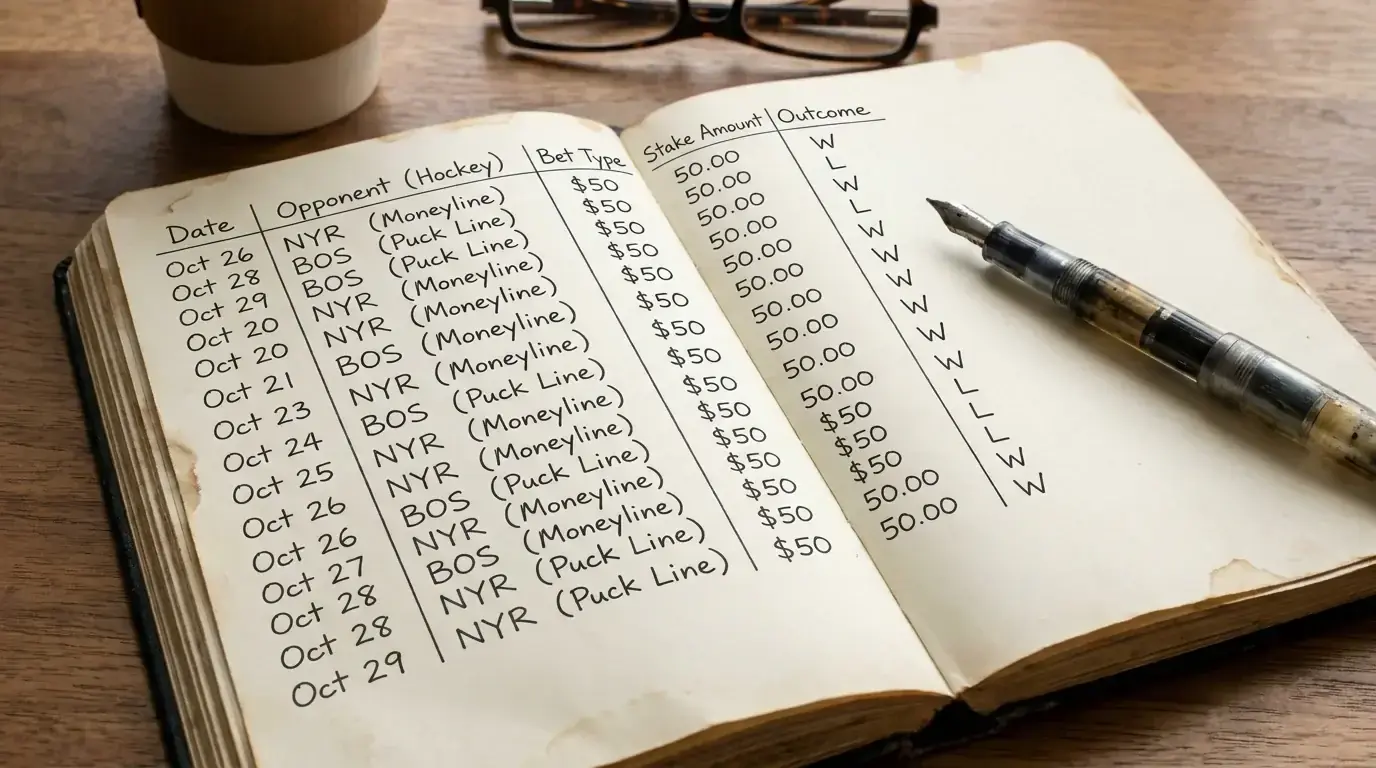
Flat staking is the simplest approach. You risk the same amount — typically 1-2% of your starting bankroll — on every bet, regardless of the odds or your confidence level. If your bankroll is £1,000, every bet is £10-£20. The advantage is discipline: you can’t chase losses by increasing stakes, and you can’t overbet on a “sure thing” that turns out to be anything but. The disadvantage is inefficiency. A bet at 1.50 (1/2) and a bet at 4.00 (3/1) carry the same stake even though the risk-reward profiles are completely different. I used flat staking for my first two seasons and it kept me alive while I learned the craft.
Proportional staking adjusts your bet size based on your current bankroll. Instead of risking £10 on every bet, you risk 2% of whatever your bankroll happens to be right now. If your bankroll has grown to £1,500, your bets increase to £30. If it’s shrunk to £600, your bets drop to £12. This self-correcting mechanism means you bet more when you’re winning and less when you’re losing — which is exactly the opposite of what most people do instinctively. The downside is that a long losing streak compounds, reducing your stakes to a level where recovery becomes painfully slow.
The Kelly Criterion is the mathematically optimal staking model, but it requires something that most bettors don’t have: an accurate estimate of the true probability of each outcome. Kelly tells you to stake a percentage of your bankroll equal to (edge / odds-1), where edge is the difference between your estimated probability and the implied probability. In practice, full Kelly is too aggressive for most bettors — a slight overestimate of your edge leads to catastrophic overbetting. I use fractional Kelly (half or quarter Kelly), which sacrifices some theoretical efficiency for dramatically improved survival odds.

Variance in Hockey Betting and How to Plan for It
Hockey is a high-variance sport. The best team in the NHL wins roughly 60% of its games; the worst team wins around 35%. That compressed win-rate range means even strong betting edges produce long losing streaks more frequently than in sports with wider talent gaps. If you’re betting moneylines at an average implied probability of 55%, you should expect losing streaks of five or more games to occur multiple times per season. Streaks of eight or nine losses happen at least once or twice. Planning for these streaks — emotionally and financially — is what bankroll management is for.

In the UK, approximately 2.7% of adults — around 1.4 million people — score 8 or higher on the Problem Gambling Severity Index. Variance is a contributing factor to problem gambling because losing streaks create psychological pressure to increase stakes, chase losses, or abandon disciplined processes. A well-structured bankroll plan removes these decisions from the emotional moment and replaces them with pre-committed rules. When I hit a losing streak now, I don’t have to decide what to do. The staking model decides for me. That separation of emotion from execution is the real value of bankroll management.
I recommend planning for a minimum of 100 bets before assessing whether your strategy is working. At 1-2% stakes per bet, that means your bankroll can absorb a worst-case drawdown of 20-30% and still have enough runway to recover. If you’re staking 5% per bet, a ten-game losing streak wipes out nearly half your bankroll, and the psychological pressure to abandon your strategy becomes immense. The math is clear: smaller stakes mean longer survival, and longer survival means more data points to evaluate your hockey betting strategy.
Setting Up Your Hockey Betting Bankroll
Your bankroll should be money you can afford to lose entirely without affecting your financial wellbeing. That’s not a disclaimer — it’s a structural requirement. If losing your bankroll would cause financial stress, you’ll make worse decisions under pressure, which defeats the purpose of having a staking plan in the first place.

I started with £500 and committed to 1% flat stakes — £5 per bet. It felt small. It felt boring. And it was the smartest decision I made in my first year of hockey betting. Those small stakes gave me room to make mistakes, learn from them, and refine my process without the financial consequences that would have driven me out of the game.
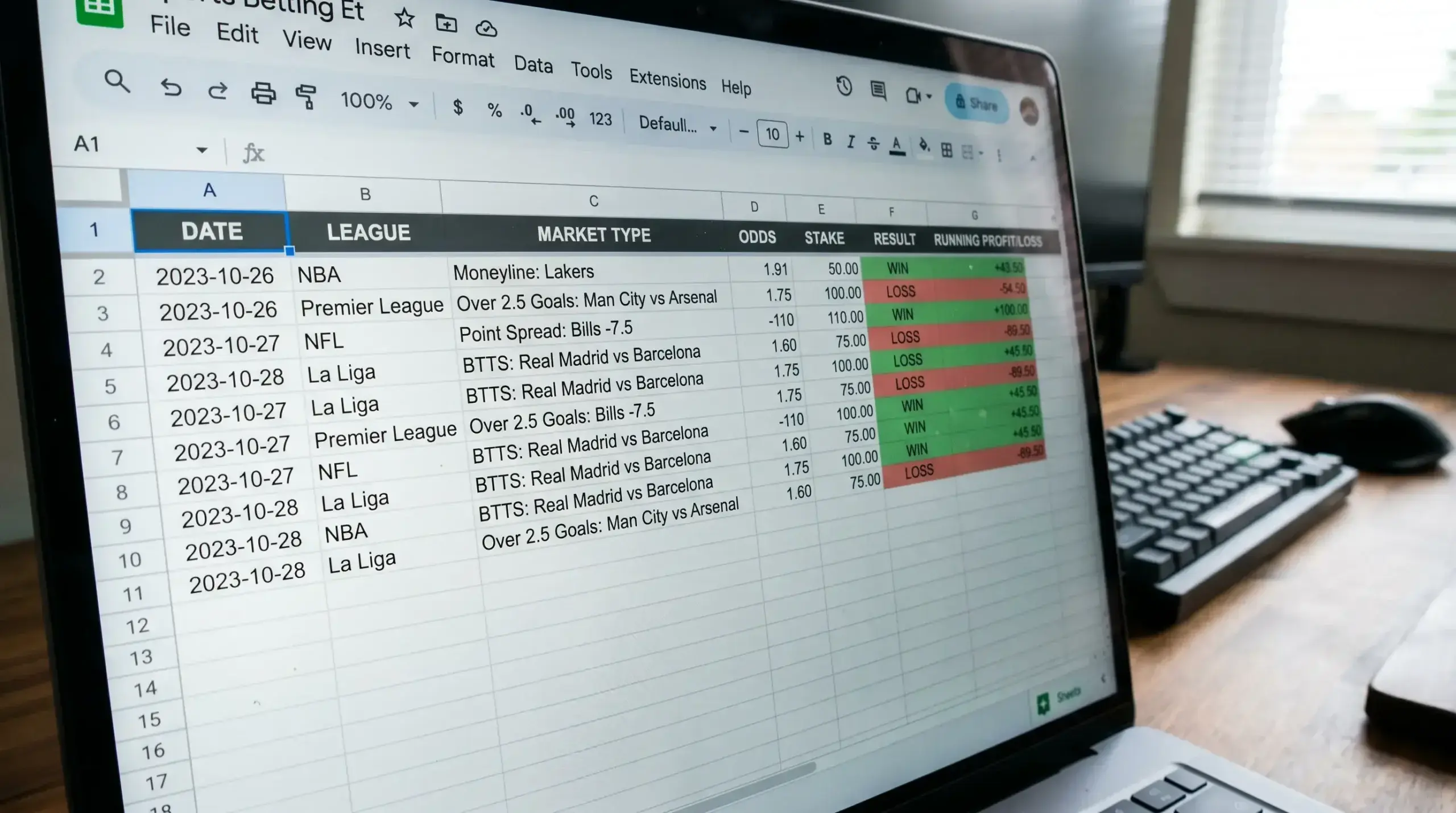
Once you’ve set your bankroll, choose a staking model and write it down. Not in your head — on paper or in a spreadsheet. Include your unit size, the maximum number of bets per day (I cap mine at four for NHL), and the conditions under which you’ll reassess your bankroll size (I review quarterly). Then follow the plan. Not sometimes. Every single time. The moment you deviate — “just this once, I’ll go bigger on this game” — you’ve abandoned the system that exists to protect you from yourself.
Track every bet in a spreadsheet: date, league, market type, odds, stake, result, running bankroll. After 100 bets, calculate your ROI, your average edge per bet, and your longest losing streak. Those three numbers tell you whether your strategy is viable, whether your staking is appropriate, and whether you’re psychologically prepared for the variance ahead. Bankroll management isn’t a one-time setup. It’s an ongoing discipline that improves as you accumulate data about your own betting behaviour.
