


What a Same-Game Parlay Is and Why It Suits Hockey
I built my first hockey SGP almost by accident. I had three opinions about a single game — the favourite would win, the total would go over, and a specific forward would score. Traditionally, those would have been three separate bets. But one of my bookmakers had just rolled out same-game parlays for hockey, and I combined all three into a single slip at 8.50 decimal odds. It hit. That payout from a single game, at odds I would never have found on any standalone market, changed how I approached hockey betting.
A same-game parlay lets you combine multiple selections from a single match into one bet. The legs can span different market types — moneyline, totals, player props, period markets — and the odds compound across all of them. New UK bookmakers have been adding roughly 34% more niche sports markets each year, and SGP functionality for hockey is part of that expansion. The product suits hockey’s structure because the sport generates a rich set of statistically trackable events within each game: goals, shots, saves, power plays, and period-specific outcomes all offer discrete betting angles that can be layered into a single wager.
The appeal is obvious: higher odds from a single game, no need to wait for results across multiple fixtures. The risk is equally obvious: every leg must win. Adding a third leg to a two-leg SGP doesn’t just increase the odds — it multiplies the ways you can lose.
How SGP Odds Are Calculated
SGP pricing isn’t a simple multiplication of individual odds, and understanding why is essential before you build one. When you combine “Team A wins” with “over 6.5 goals,” those outcomes are correlated — if the favourite wins comfortably, a high-scoring game becomes more likely. The bookmaker’s SGP engine adjusts for this correlation, which means the combined odds are lower than you’d get by naively multiplying the individual prices.

The degree of adjustment depends on how strongly the legs correlate. Two highly correlated legs — like “Team A wins” and “Team A over 2.5 goals” — receive a larger adjustment (less favourable odds) because both outcomes are driven by the same underlying event: Team A’s offensive dominance. Two weakly correlated legs — like “Team A wins” and “Player X records over 3.5 shots on goal” — receive a smaller adjustment because one player’s shot volume doesn’t strongly determine the game’s outcome.
Bookmakers don’t publish the correlation models they use, and the adjustments vary from operator to operator. I’ve compared SGP pricing across three major UK bookmakers for the same combination on the same game and found differences of 15-20% in the final odds. That’s significant. It means shopping your SGP is just as important as shopping your moneyline.
One detail that often goes unmentioned: the bookmaker’s margin on an SGP is typically higher than on any of the individual legs. Each leg carries its own margin, and the compounding effect means the total overround on a four-leg SGP can exceed 15-20%. You’re paying for the convenience of combining markets that traditionally couldn’t be combined.
Correlated and Uncorrelated Legs in Hockey SGPs
The distinction between correlated and uncorrelated legs is where SGP strategy lives or dies. A well-built SGP exploits correlation in your favour. A poorly built one stacks uncorrelated risks that each need to break your way independently.
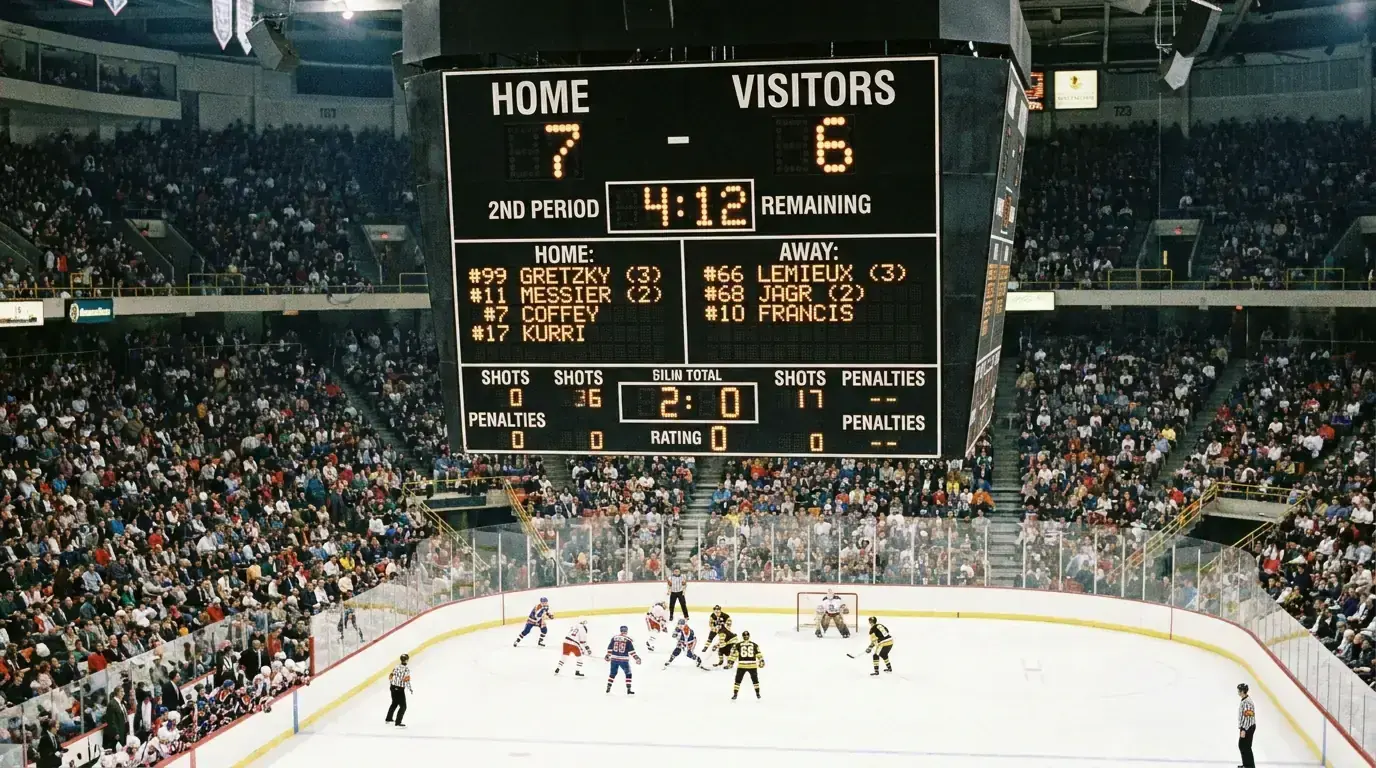
Positively correlated legs move together. “Over 6.5 total goals” and “yes — both teams to score 2+” are positively correlated. If the total clears 6.5, it’s overwhelmingly likely that both teams contributed at least two goals. Adding this combination doesn’t meaningfully increase your risk compared to betting the over alone, but the SGP engine gives you extra odds for it. That’s where value hides.
Negatively correlated legs work against each other. “Team A wins by 3+” and “under 5.5 total goals” is a difficult combination. For Team A to win by three or more in a game with fewer than six total goals, the opposing team can score at most one or two. That’s a narrow scoring matrix, and the odds should reflect how narrow it is. If the SGP prices this combination generously, it’s because the correlation model underestimates the difficulty.
Player props are typically low-correlation with game outcomes, which makes them interesting SGP additions. A forward’s shots on goal total depends on his ice time and usage, not on whether his team wins or what the total score is. Adding “Player X over 3.5 shots” to a moneyline-plus-total combination layers in an independent event at near-full odds, which is exactly what you want.
My rule of thumb: no more than three or four legs per hockey SGP. Every additional leg compounds the margin you’re paying and the probability of failure. I’ve seen bettors build eight-leg SGPs on a single NHL game, and while the potential payout is enormous, the expected value is deeply negative. The product is designed to be exciting. Your job is to make it analytical.
Building a Hockey SGP: Step-by-Step Example
The share of live betting in total handle exceeded 50% at DraftKings in early 2025, and SGPs are increasingly being offered for in-play markets too. But let’s start with a pre-game build, which is where most UK bettors will use this product.
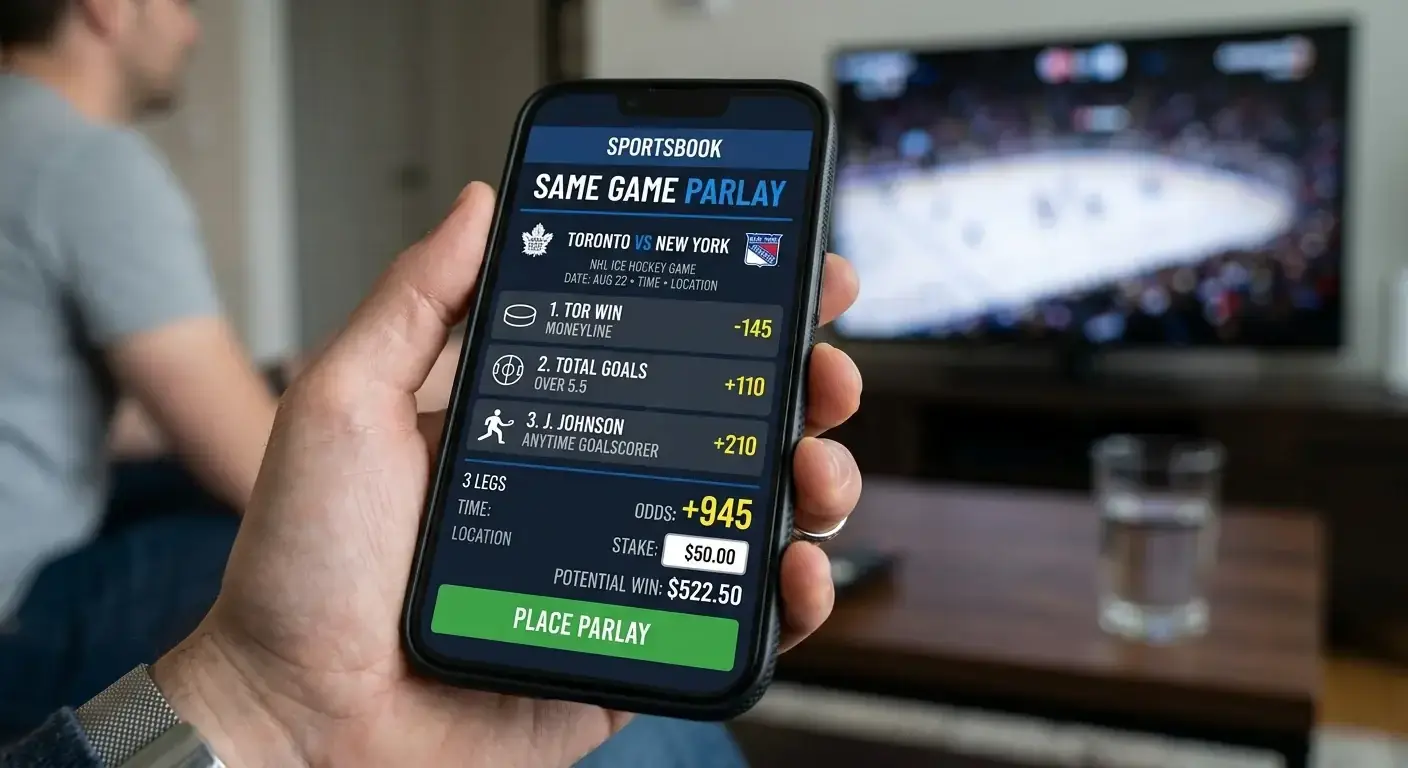
Step one: form your core opinion about the game. Pick the outcome you feel strongest about. For this example, say you believe the Edmonton Oilers will beat the Calgary Flames at home. That’s your moneyline leg — Oilers ML.

Step two: identify a correlated supporting leg. If you think Edmonton’s offence will dominate, “over 6.5 total goals” aligns with that view. Edmonton’s games average among the highest totals in the league when their top line is firing. This is your second leg.
Step three: add a low-correlation player prop. Connor McDavid averages 4.2 shots on goal per game. The line is set at 3.5. His shot volume is independent of whether the game total hits or whether Edmonton wins by one goal or four. This becomes your third leg.
You now have a three-leg SGP: Oilers ML + over 6.5 + McDavid over 3.5 shots. The individual prices might be -160 (1.63), +100 (2.00), and -130 (1.77). A naive multiplication gives 5.77 decimal. The SGP engine, adjusting for correlation between legs one and two, might price it at 4.80-5.20 decimal. That’s your realistic payout range.
Step four: compare the SGP price across at least two bookmakers. If one offers 5.20 and another offers 4.60, the extra value on the higher-priced slip is meaningful over time.
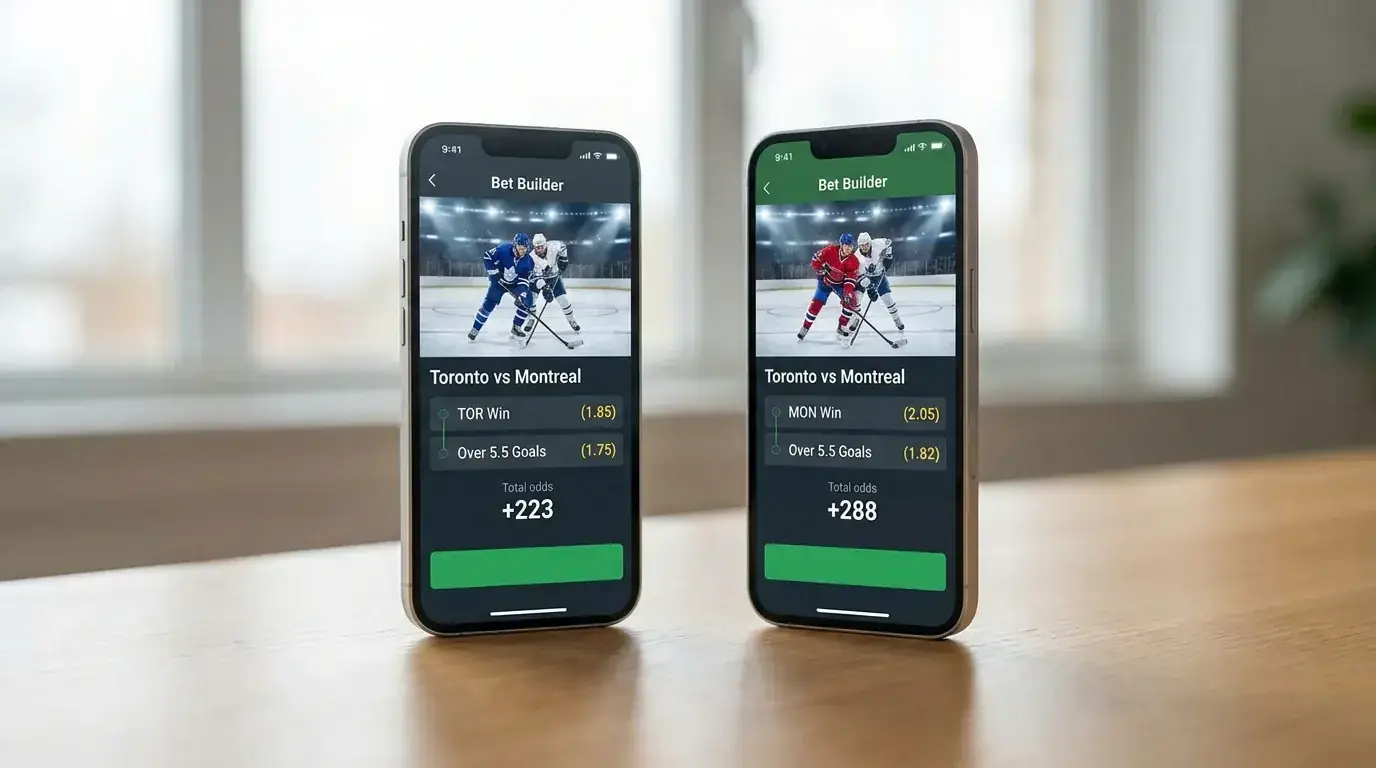
Step five: size your stake. SGPs are higher-variance than single bets. I allocate no more than 1% of bankroll per SGP, compared to 2-3% for a standard moneyline. The Bet Builder interface at most UK bookmakers makes this process straightforward — select your legs, review the combined odds, and confirm.
